Objective 5: Water, Sanitation & Hygiene (WASH)
About This Programme
Access to safe drinking water remains one of the most urgent needs in the rural communities Helping Aid Foundation serves. Families, most often women and children, walk long distances each day to collect water that is frequently unsafe to drink.
Our WASH programme exists to improve access to clean drinking water, sanitation facilities, and hygiene awareness in underserved communities. Every installation is built with the community, handed over to the community, and maintained locally so it keeps serving families long after the work is finished.
To date the Foundation has completed 85 clean water projects across Dera Ismail Khan District in Khyber Pakhtunkhwa. They are not one repeated design. What a community needs depends on whether groundwater is present, how deep it sits, whether there is any grid electricity to reach it, and whether the water already available is safe to drink, so the installations differ from village to village.
Where groundwater is available but there is no reliable electricity, we install a solar water pump. Panels drive the pump directly, so the system needs no grid connection and no diesel. That matters more over time than it does on the day of installation. A system that runs on fuel carries a monthly cost the village has to keep finding, and that recurring cost is a common reason such systems stop working within a few years.
Where water already reaches a community but is not safe to drink, the answer is a water filtration plant rather than a new source. A filtration system serves a whole settlement from a single point and removes the contamination that makes the existing supply a health risk, particularly for young children.
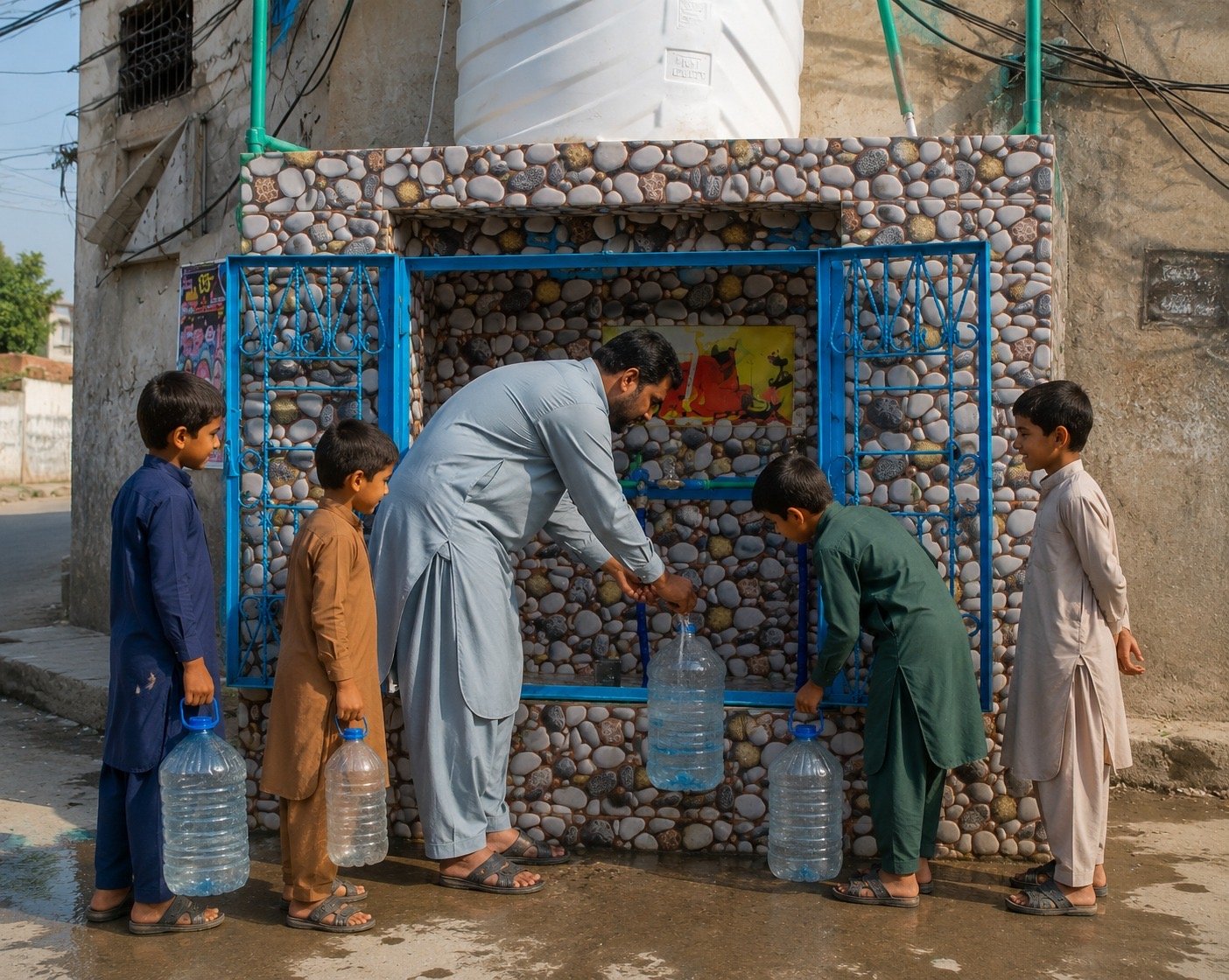
Alongside pumps and filtration, the programme rehabilitates water infrastructure that has broken down, builds community water access points and storage, and runs hygiene awareness sessions. Safe water and hygiene practice work together. A clean supply does not protect a family on its own if the water is then stored or handled in a way that contaminates it again.
Every project is built with the community rather than delivered to it, and handed over once it is finished. Local ownership and local maintenance are what keep a water point running for years instead of months.
A solar water pump project costs between USD $1,500 and $3,500, depending on the depth of the water and the number of households it serves. A water filtration system costs between USD $3,000 and $10,000. Donations to this programme fund those installations in Dera Ismail Khan.
Programme at a Glance
- Programme area Dera Ismail Khan District, KPK
- Projects completed 85 clean water projects
- Strategic objective Objective 5: WASH
- Status Active, expanding
Key Activities
- Solar water pump installations
- Community water facilities
- Water infrastructure rehabilitation
- Hygiene awareness programs
- Water filtration plants
- Community water access points
From the Field
What Your Support Funds
Building on previous successful water projects, the Foundation plans to expand access through additional solar-powered pumps, filtration systems, storage and community access points.
- Solar Water Pump Project USD $1,500 to $3,500
- Water Filtration System USD $3,000 to $10,000